10 de Dec 2025 | Coffee
Peru accelerates its preparation for the EU’s zero-deforestation regulation: progress, challenges, and lessons on the road to EUDR compliance
Over the past year, companies and organizations have brought their internal systems closer in line with buyer requirements.
The beginning
On April 19, 2023, the European Parliament enacted the European Union Deforestation Regulation (EUDR), aiming to ensure that the consumption and processing of raw materials within the EU does not contribute to deforestation. With 552 votes in favor, 44 against, and 42 abstentions, the regulation was broadly supported and marked a new direction for global trade: the normalization and integration of environmental criteria into international commerce.
In the years since, producing countries around the world have expressed concern, interest, and taken action to adapt to the new rule. For coffee, the EU remains the main destination for most Latin American exports—a result of European preferences for mild, washed, high-quality coffees, increased trade agreements, and market diversification. As shown in the chart below, the EU is the number-one destination for Honduras, Brazil, and Peru, and the second most important for the rest of the countries.

Source: Enveritas, July 2025 presentation.
In Peru, adaptation efforts have been broad. In May 2023, during the National Convention, various public institutions presented their proposals and actions, while international cooperation agencies announced new projects to support producers through this transition. From a practical standpoint, the EUDR became linked to the government’s Agricultural Producers Registry, aiming to strengthen traceability and reliable data. However, until mid-2025, one critical question had been largely overlooked: What were companies actually doing to comply with the regulation? This is especially relevant because liability for non-compliance falls on the importer of the commodity.
International cooperation and the need to align efforts
In May 2025, during the 27th Convention, two major multinational exporting companies presented their own systems for adapting to the European regulation. One phrase summarizes the takeaway: The challenge is not the data itself, but how it is managed and used. Producers remain the owners of their information.
In July, within the framework of the Coffee and Forests Agreement, a workshop was held to review the progress of EUDR implementation. Enveritas, a leading compliance verification organization (and currently the most widely used mechanism in the coffee industry), presented a comparative analysis of LATAM efforts. The findings showed a strong prioritization of data generation—particularly geolocation. However, data quality verification is still lacking, and the use of such data is not yet aligned with EUDR compliance. The central question remains: “What will companies do to guarantee compliance?” In other words, once deforestation risk is identified, what strategies and actions will be implemented to prevent it?

Two key issues emerged during the workshop. First, a general lack of detailed knowledge of the regulation—who it affects, the producer’s role, and how it may impact commercial operations. This stems partly from companies and cooperatives approaching the EUDR from an administrative, rather than business-oriented, perspective. Second, an excessive focus on public-sector and cooperation initiatives aimed at producers, with limited attention to the rest of the supply chain. The business sector’s practical insights also remain underrepresented.
This gap was accurately identified by the Embassy of the Netherlands in Peru, which supported field workshops and activities that enabled actors to better understand how cooperatives and medium-sized companies are adapting, while also providing an appropriate and sector-specific technical language.
Workshops in Pichanaki and FICAFE
On October 9, a workshop was held in Pichanaki with 60 participants from across the supply chain. Over three hours, the discussion centered on the scope of the EUDR, producer responsibilities, organizational actions, and available pathways for compliance. A notable highlight was the participation of the José Santos Atahualpa Cooperative, which has strategically focused its portfolio on the German market.
“We spoke directly with the buyer. They told us which system they preferred, so we adopted it with our producers,” they explained. According to the cooperative, the EUDR requirements also helped strengthen their internal traceability and management systems:
“We conducted an in-depth study of our producers using drones—not just GPS points—achieving greater precision. Aligned with the buyer, we established improvement and mitigation plans that will be evaluated in the coming years.”

For many actors—particularly cooperative managers—platforms like Rainforest Alliance’s Multitrace were previously perceived as tools for basic reporting. However, the field activities revealed the full scope and level of access producers and their organizations can have across different supply-chain stages. The Pichanaki session closed with strong interest in understanding how market actors use the information they consistently request from producers.
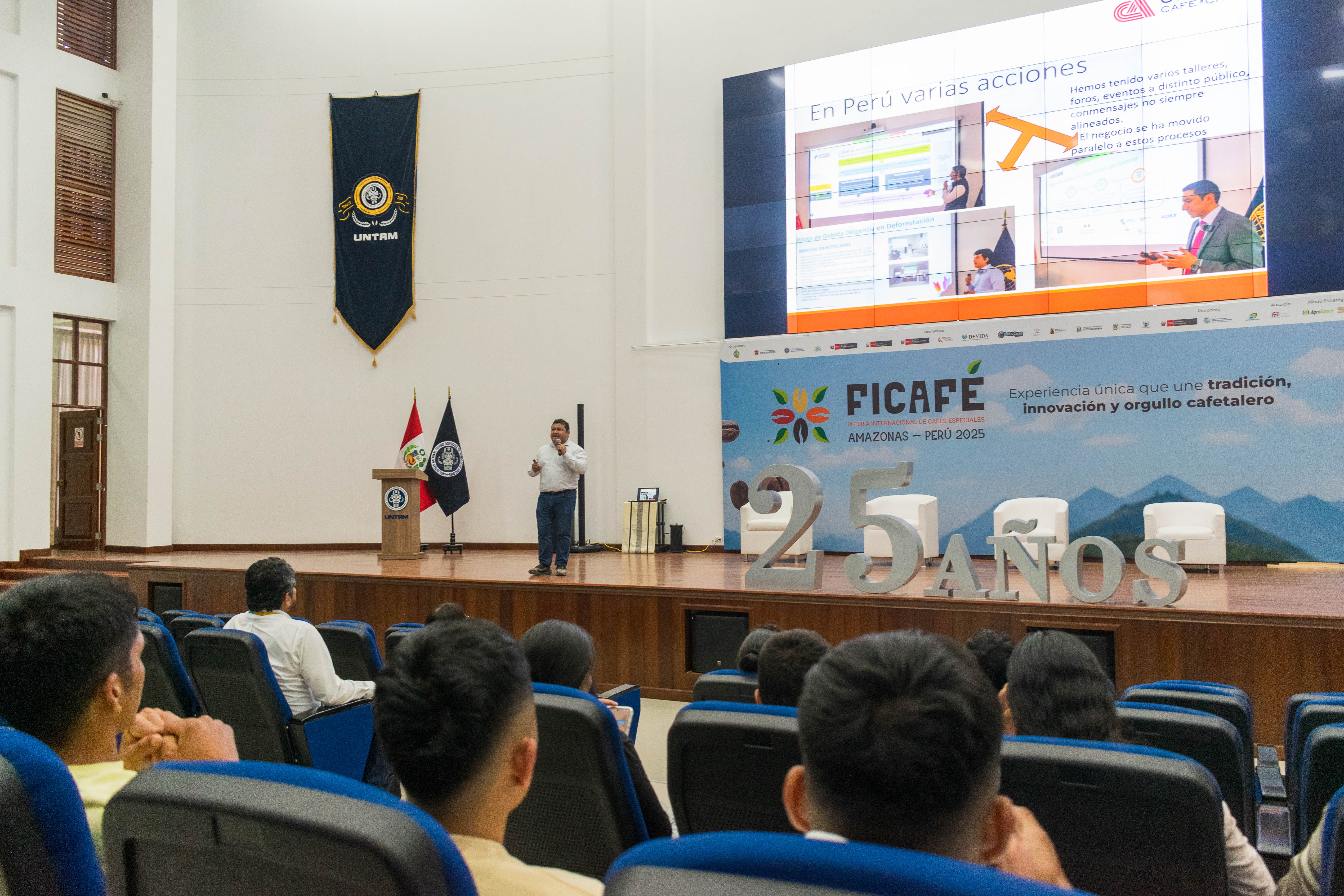
On November 7, a complementary session was held at the International Specialty Coffee Fair (FICAFE)—the only technical presentation on the EUDR during the event. Panelists included UK cooperation projects and an expert in internal control systems. The session reviewed the regulation’s status across the region and confirmed that many cooperatives and companies have developed their own compliance systems—some aligned with buyer requirements, others supported by cooperation and financing opportunities. Across all cases, the need to strengthen internal control systems was evident, as EUDR-aligned tools are built on top of these foundational structures.

Audience questions focused on whether the EUDR could lead to price discrimination—still an open question—and on the legal implications for future implementation stages, which will require alignment with national institutions capable of supporting compliance.

The EUDR as an opportunity
The EUDR has created closer interaction between European buyers (the obligated entities) and Peruvian exporters. This has led to tighter alignment of processes to ensure that documentation prepared by Peruvian exporters meets the due-diligence requirements of European importers. Beyond public-sector initiatives and support for producers, the private sector is facilitating collaboration between key supply-chain actors. Selling coffee is no longer just about exporting a product—it now requires implementing control and traceability systems that can reliably demonstrate compliance.
Companies such as PRONATUR and the José Santos Atahualpa Cooperative have adopted different approaches—some aligning fully with buyer systems, others integrating new standards consistent with the European market. As a result, Peru’s adaptation to the EUDR does not rely on a single solution but rather a diversity of information-management and documentation systems that together help guarantee traceability.
Why is this important? Historically, many initiatives sought a “single solution” under the assumption that one system or institution could “guarantee compliance.” This frequently led to perceptions of imposition. Today, however, at least ten different systems are being used in Peru to meet EUDR requirements—from standards such as Rainforest Alliance, Naturald, and Fairtrade, to verifiers like Enveritas and global geospatial platforms such as Global Forest Watch and Geobosque.
Where we stand now
Approximately 40% of Peruvian coffee is certified, most under standards that complement EUDR requirements. It is estimated that 50% of coffee production will undergo EUDR verification.
Major companies and cooperatives have already aligned their due-diligence processes with buyer expectations. This covers a significant share of medium and large operations, though small enterprises and cooperatives still face logistical challenges to adapt.
Beyond complying with zero-deforestation criteria, Peru has made public commitments to legality and formalization—supported by cooperation initiatives that aim to strengthen reliable information systems and well-designed processes. Together, these elements position Peru to navigate the EUDR as both a challenge and an opportunity, leveraging national institutional capacity and the seriousness of its supply-chain actors.