15 de Jul 2021 | Coffee
The specialty coffee shop: from Lima to the regions
Parallel to the boom in coffee brands, coffee shops have expanded into producing regions, giving shine and perspective to the business in the chain.

The coffee sector has been able to overcome the adversity of the pandemic and low international prices in previous years. The emergence of coffee shops and the consolidation of specialized local consumption has led to a new generation of players in the business.
On one hand, the growth of specialty coffee shops has made the leap from regions in particular to producing areas. According to Euromonitor, the number of specialized coffee shops in Peru grew on average by 13% in the period 2012-2017. These coffee shops use coffee that comes from the main producing regions, with which they establish a commercial link, most of the time direct: low volume requires high quality.
In this way, part of the exportable supply of high-quality and specialty coffees has been transferred to the domestic market and is well received by the local consumer. Today several coffee shops in Peru are linked to cooperatives in the producing provinces, as they are a positioning channel for local coffee. This type of business brings producers closer to consumers through the direct retail sale of coffee-based beverages in bean or ground formats. With this added value that the channel provides, the producer can obtain a better price for his crops (Omar Narrea, 2020).
This process is decentralized and has been moving closer to the production areas, where the growing development of quality systems, with laboratories and small roasting plants, has promoted a local offer that aligns the production area with the consumer, this consolidates the formation of baristas, tasters and other actors that give a coffee identity to the producing area, in addition to bringing together generations and links, loyalty to the actors.
A representative case is the district of Pichanaki, where 5,600 producing families reside with an annual consumption and expenditure on coffee of 1 kg and 36 soles respectively. According to Efraín Chipana, general manager of PROCAFES, an association for the promotion of specialty coffees Selva Central, the coffee market alone in the city moves approximately 4 million soles a year. The municipality recognizes the magnitude of its internal market and joins in the promotion of coffee consumption, which also opens an institutional channel.
The city has 25 coffee shops, which are supplied with coffee from 15 cooperatives in Junín. In addition, they have 40 baristas, who are children of farmers and reinforce their link with the chain. Thanks to the business, jobs are emerging for the youth segment in management and marketing, where commercial interest also grows to work in the coffee value chain and specialize in a task that brings its local coffee closer to the consumer.
Coffee shops require high standards of service, supplies, design and brand management. The latter promotes the diversification of the coffee offer to a Peruvian public increasingly involved in the coffee culture. For this reason, distinctive signs emerge for local coffee, according to Indecopi (2020) these can be: individual, collective, certification and denomination of origin brands.
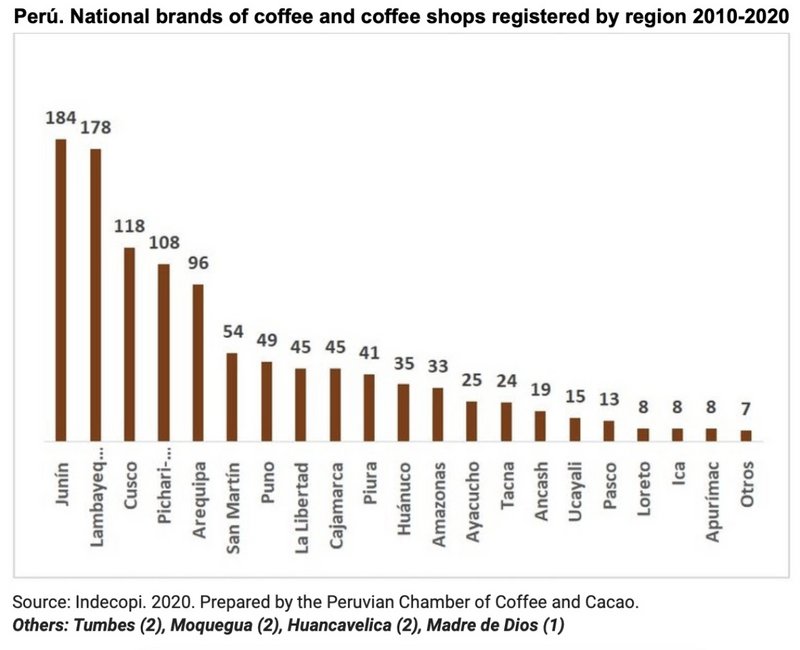
Producers use individual marks to differentiate their coffee from the competition, collective marks to indicate that their coffee shares the same characteristics as those of a group of producers, certification marks to guarantee the qualities of their coffee to third parties, also the denomination of origin to protect the origin of the coffee and the reputation linked to its production area. The growth of this process goes hand in hand with the development of coffee shops that also seek their differentiation. Outside of Lima, in the period 2010-2020, a greater number of national brands of coffee shops and coffee were registered in the provinces of Junín (184), Lambayeque (178), Cusco (118), Pichari-Vraem (108), Arequipa (96), San Martín (54), Puno (49), La Libertad (45), Cajamarca (45), and Piura (41). Precisely the coffee-producing provinces. In the case of Lambayeque, there is a relationship with its consolidation as a regional coffee supplier on the north coast of Peru.
There is a movement of coffee shops associated with producers throughout the country, as an alternative to exporting coffee to obtain better income and to serve specialized clients. The closure of some foreign markets during the pandemic made high-quality Peruvian coffee stay at home and the offer is adapted to the budget of local consumption. The cafeterias play a fundamental role in the accessibility of this product to the consumer, they are not only a point of sale, but also help in consumer education.
The actors who play a key role in the movement are entrepreneurs: coffee shop owners and baristas, most of them young people who have invested capital, expertise and passion, bringing a new vision to the business. At the dialogue table "Let's talk about coffee" at the 23rd National Coffee and Cacao Convention, organized by the Peruvian Chamber of Coffee and Cacao within the framework of the Alliance for Sustainable and Competitive Coffee Project, 10 entrepreneurs and baristas participated, enriching the perspective of the business model of coffee shops supplied by coffee from producing provinces.
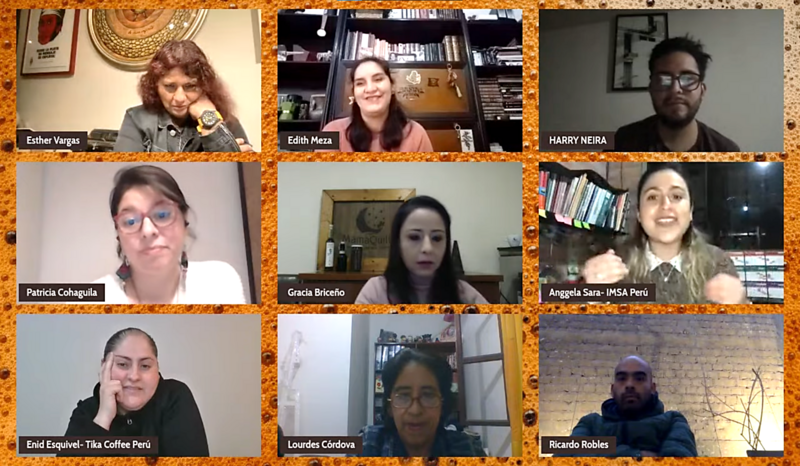
Anggela Sara from IMSA Peru stated that, despite the situation, this year has seen a boom in small local coffee brands and coffee shops due to a greater commitment of the Peruvian consumer to Peruvian coffee. This benefited Jhon, who has opened his second D ’Wasi cafeteria in Cusco, managing to expand his business by offering more accessible prices to the local consumer, and also captivating young people, who are increasingly showing interest in experimenting with preparation methods.
Harry Neira, from Neira Café, highlighted that only the illusion of having a cafeteria is not sustainable; an operating manual and a business strategy must be in place, as stability implies meeting additional requirements. For this reason, ventures also require the guidance of experts. This goes hand in hand with the professionalization process that the chain is experiencing: many young people enter with specific training or experience that they incorporate into the business, giving a new dynamic to the cupping, roasting and coffee preparation processes, both for the home and outside of it: the experience of having a coffee is an evocation that in the Cafeteria Contest of the Peruvian Coffee and Cacao Chamber evaluates in 48 variables.
There is an effort to promote quality and variety in all consumer spaces. Ricardo Robles, from the Bombilla Roaster, supplies restaurants with high-quality Peruvian coffee, thus promoting customer education outside the home. Enid Esquivel, from Tika Coffee Peru, added the importance of educating the consumer about the quality of coffee through social networks; Gracia Briceño from Mama Quilla, highlighted that this education offers the opportunity for potential consumers to appreciate innovations, such as the latte art promoted by Vanessa Fabián de Ascaso.
On the other hand, Lourdes Córdova, a cupping professor at the Peruvian Coffee and Cacao Chamber, indicated that a national coffee policy is needed to unite the aforementioned individual efforts. Patricia Cohaguila from Pausa Café supported this opinion, mentioning that in a possible next context of uncertainty, political crisis and pandemic, it would be hard for the cafeteria community to survive without a policy to support them.
Added to this is the experience of Edith Meza, from Finca Tasta in Junín, who during the pandemic experienced the closure of transportation routes to work with native communities in the province. He affirmed that although Peru has a great opportunity in which different geographical conditions can provide different coffee profiles; There is a great challenge in infrastructure that supports the commercialization of the product.
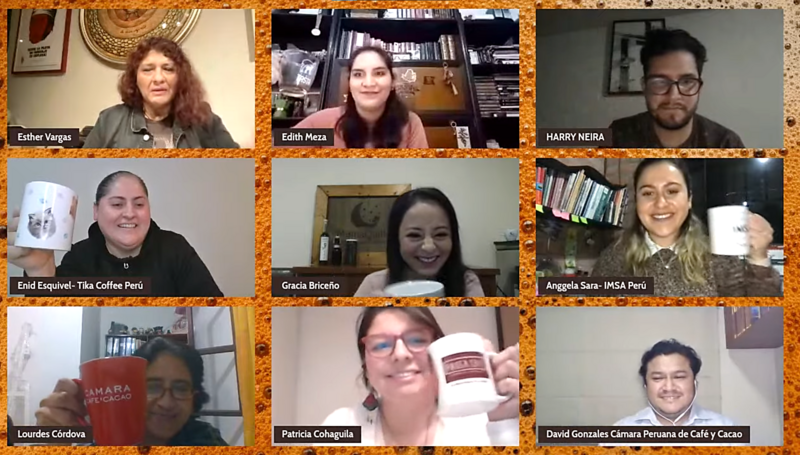
Synthesizing ideas is a complex task, this table moderated by Esther Vargas from the Peruvian Coffee Route, had several contributions in which we can review:
Anggela. -Form neighborhood cafeterias through word of mouth recommendation.
Edith. -Create rituals to generate the habit of consumption
Enid. -Sell a quality product through social networks.
Harry. -Develop a national strategy to unify efforts
Grace -Show the consumer the versatility of coffee: show the range through unique experiences
Patricia. -Make visible in national policy the efforts of coffee shops that work with coffee from producing provinces
The Alliance for Sustainable and Competitive Coffee project is promoting these spaces for dialogue in order to include the various actors and regions in promoting a consumption agenda that guides and supports producers, entrepreneurs and consumers. The country will drink more coffee in the future, we must go into it together.