

Article | Dec 14, 2021
Tailor-made agroforestry in Peru
Collaborative agroforestry design combines empirical and technical–scientific knowledge, making responses possible to the specific circumstances of farmers.
.jpg)
The farms of Don Santos Acha and Don Emilio Lavajos, coffee producers from Moyobamba in San Martin, Peru are part of an innovative process of co-learning for the collaborative design and implementation of demonstration plots of agroforestry practices, undertaken by World Agroforestry (ICRAF). This is a process wherein the farmer is at the centre and where his or her particular context points to the most appropriate option for agroforestry.
‘We don't come with a model, we don't come with a recipe; we come with an approach of co-construction, reflection and learning,’ said Valentina Robiglio, senior land-use systems scientist and scientific coordinator for Latin America at ICRAF.
The co-learning process is one of reflection that brings together technical and scientific knowledge with the empirical knowledge of producers. In this way, the design of agroforestry practices is jointly constructed based on the evaluation of the context, that is, the productive, socio-economic, cultural and environmental dimensions; and a farmer’s aspirations, capacities and skills. In the co-design of agroforestry systems and practices, the farmer is the protagonist.
‘We have made a design according to our own reality, specifically in this area of Moyobamba,’ explained coffee farmer Lavajos. ‘The methodology has seemed very important to me because we have been used to doing other tasks, such as burning to prepare the soil. This is a new methodology that we want to develop and compare with what we have been doing before. In the future, we want to see the results of this work.’
An experience of co-learning in coffee agroforestry
This is within the framework of the Sustainable and Competitive Coffee Alliance project, funded by the SeCompetitivo programme, which ICRAF initiated in January 2020. It is a thorough co-learning process for the collaborative construction of agroforestry design, bringing together local producers and technicians, as well as national and international scientists and researchers.
Based on the ‘options by context approach’, ICRAF recognises that adoption and success factors for implementation of an agroforestry practice depend on the circumstances in which families operate and the socio-ecological, legal and institutional contexts. Within this framework, a five-phase process of co-learning has been proposed: diagnosis, planning, implementation, monitoring and evaluation.
The diagnosis helps to have more realistic designs within a producer's reach — designs that they themselves could implement and manage in the long term — by providing inputs to know in what state the soil of the plot is in, what the farmer’s objective is and what resources they have to achieve it according to the conditions of the plot.
As part of this diagnosis, biophysical analysis is crucial.
‘If you are going to do agroforestry, you need to know under what conditions you are going to put the trees and crops, how they are going to relate to each other over time and how they are going to respond to soil conditions and other biophysical and climatic factors,’ explained María Baca, ICRAF’s coffee and tropical crops specialist, who designed and led the process. ‘This type of process is needed so that farmers know how to produce and manage their plant species at the plot level. A superficial soil analysis, which is what is usually done, is not enough.’
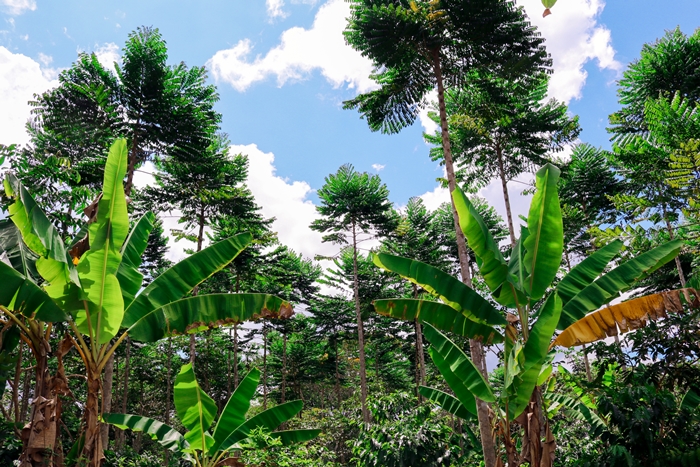
Agroforestry system with coffee, banana and a native tree species in Moyobamba, San Martin, Peru.
Photo: ICRAF/Mey Lin Chiang
Photo: ICRAF/Mey Lin Chiang
As part of the co-learning process, tools developed by ICRAF have been used to support the diagnosis and co-design of agroforestry systems: PLANTSAFS (for diagnosis towards design and management), AmazonSAF (for economic and financial analyses) and CarbonSAF (to preliminarily estimate the carbon content of the designed options).
Design ‘with the face of the producer’
As already mentioned, collaborative design, also known as co-design, is built between the producer and others. In the case of the project in San Martin, several meetings were held to exchange knowledge and validate the agroforestry co-designs developed by the project team. In October 2021, ICRAF brought together experts and researchers, technicians and coffee producers to define the principles for the co-design of the demonstration plots of Acha and Lavajos, who not only participated but at times led the discussion.
‘In the designs that have been made, the face and voice of the producers can be seen and heard; it is not just a design by technicians,’ said Andrew Miccolis, country coordinator of ICRAF Brazil and creator of the PlantSAF and AmazonSAF tools. ‘They have come up with designs with the face of San Martin: with their preferences and lessons. For me, this is the best indicator of the success of the methodology: when the design has the face of the farmer.’
Conventional versus agroecological management
In coming days, the designs will start to be implemented in the demonstration plots. In Acha’s plot, work will be done to recover soil fertility in a system with fewer tree species, less shade and a higher density of full-sun coffee.
To diversify his income, he will add forest and fruit species. In Lavajos’ plot, the aim is to restore the soil to its optimal physico-chemical condition — in a system with a greater diversity of forest and non-forest species — to diversify his income. He will also seek to increase the yield and quality of the coffee he grows.
Based on these agroforestry designs, both plots will be divided in two to compare the producer's conventional management with the agroecological management proposed by the project.
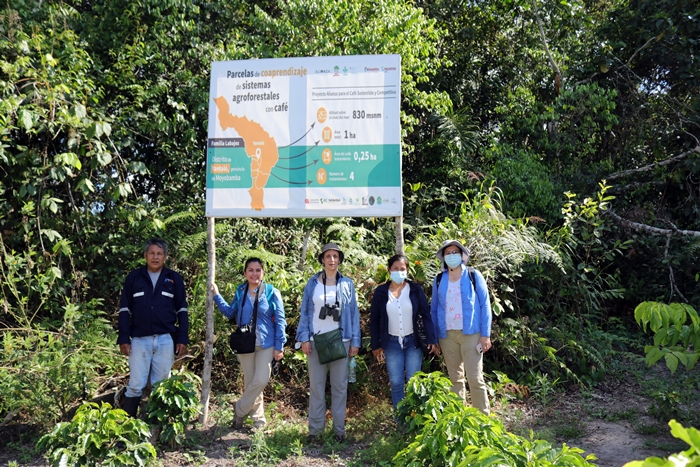
ICRAF team and producer Emilio Lavajos in a co-learning plot of agroforestry systems with coffee in San Martin, Peru.
Photo: ICRAF/Mey Lin Chiang
Photo: ICRAF/Mey Lin Chiang
Taking into account that the application of agroecological management can generate various pathways for a shift towards more sustainable agricultural and food systems, the ICRAF team have been guided by the agroecological principles defined by the High Level Panel of Experts of the United Nations Committee on World Food Security. The titles of the principles prioritised in the plots are recycling, input reduction, soil health, biodiversity, synergies, economic diversification, co-creation of knowledge, land and natural resource governance, and participation.
What else is needed to bring about change? This idea may help us find an answer:
‘It is not only researchers who must accept, adopt and adapt the new modes of thinking and action required to address options by context interactions, they also need be taken up and further developed by extension and change agents in the public and private sectors,’ wrote Fergus Sinclair, ICRAF senior scientist in, The options by context approach: a paradigm shift in Agronomy. ‘It is only through co-development of methods involving these constituencies, working closely with farmers that progress is likely to be made.’
The Sustainable and Competitive Coffee Alliance project is implemented by an alliance of ICRAF, Peruvian Chamber of Coffee and Cocoa, National Coffee Board and Solidaridad. It is financially supported by the SeCompetitivo Programme, an initiative of Swiss Cooperation in collaboration with the Ministry of Economy and Finance and its financial executor in Peru, Helvetas.